The Millennium-long Carrier of Colors: The Evolutionary Course of Drawing Paper History
October 23, 2025
zj1821484871@gmail.com
From primitive carvings on rock walls to ancient Egyptian documents on papyrus, and then to professional drawing papers that hold timeless artworks in today’s art galleries, drawing paper, as a vital carrier for art and records, has a development history that is not only a story of material and technological iteration but also reflects humanity’s unceasing pursuit of a carrier that is “portable, durable, and easy to create on”. The birth and popularization of each type of drawing paper are deeply intertwined with the artistic needs and production standards of its specific era, ultimately becoming a key force driving the diversification of artistic creation.
I. Ancient and Archaic Civilizations: The “Embryonic Era” of Drawing Paper (3000 BCE – 2nd Century CE)
Before the emergence of “paper” in the true sense, humans had already begun to seek carriers for images and texts. These primitive “drawing papers”, though diverse in form, laid the foundation for the development of drawing paper in later generations.
Ancient Egypt was one of the earliest civilizations to nurture a “portable carrier”. Around 3000 BCE, Egyptians discovered papyrus reeds in the Nile Delta. By peeling the reeds, cutting them into thin slices, stacking them crosswise, beating them with hammers, using the moisture of the Nile to bond the fibers, and finally flattening and drying them, they created “papyrus”. This carrier was lightweight, flexible, and could well absorb mineral pigments. Most of the painted Book of the Dead and religious ritual paintings of ancient Egypt were created on it. The appearance of papyrus transformed painting from rock walls and stone stelae to a “portable” form, and it also became an important medium for the spread of ancient Egyptian civilization.
During the same period, in the Mesopotamian region (the “Cradle of Civilization” between the Tigris and Euphrates Rivers), people chose “clay tablets” as carriers. They carved patterns on wet clay tablets with styluses, and after firing, hard “clay tablet paintings” were formed. However, clay tablets were heavy, difficult to transport, and unable to hold delicate colors, so they were gradually replaced by more portable carriers. In China, during the Shang and Zhou dynasties, “oracle bones” and “bronze artifacts” were the main carriers for carvings. From the Warring States period to the Western Han dynasty, “silk paintings” (with silk fabrics as carriers) were closer to the nature of “flexible drawing paper”. The T-shaped Silk Painting unearthed from the Mawangdui Tombs in Changsha used a delicate silk fabric as the base, and with pigments such as cinnabar and azurite, it depicted complex scenes of the heavenly realm, the human world, and the underworld. The softness and delicacy of silk paintings allowed for more precise presentation of painting details, but silk was costly, so it could never be widely popularized.
The “embryonic forms of drawing paper” in this era either relied on local specialties (such as papyrus and silk) or were limited by material properties (such as the heaviness of clay tablets). Although they met the basic need of “carrying images”, they generally had problems such as “high cost, low output, and limited portability”, making it difficult to meet the needs of mass creation or large-scale artistic dissemination.
II. The Breakthrough of Chinese Papermaking: The Birth of True “Drawing Paper” (2nd Century CE – 12th Century CE)
In 105 CE, Cai Lun, a eunuch of the Eastern Han Dynasty, built on the experience of his predecessors in “making flocculent paper from flax fibers” and improved the papermaking technology. Using low-cost raw materials such as tree bark, rags, hemp ends, and fishing nets, he created “Caihou Paper” through the process of “cutting materials → boiling to soften → pounding into pulp → forming paper sheets → drying”. This invention was not only a revolution in writing carriers but also marked the official birth of “drawing paper” in the true sense.
Early paper was mainly “hemp paper”, with thick fibers and a relatively thick texture, mainly used for writing. However, with technological improvements, paper gradually developed towards a “specialized for painting” direction. During the Wei, Jin, Southern and Northern Dynasties, painters began to try creating paintings on paper. The Admonitions of the Instructress to the Palace Ladies (a copy) by Gu Kaizhi might have been based on the embryonic form of early rice paper. By the Tang Dynasty, the craftsmanship of “rice paper” (also known as “Xuan paper”) gradually matured. Craftsmen in Xuanzhou (now Xuancheng) in Anhui Province used high-quality local sandalwood bark and paddy straw from sandy fields as raw materials, and through natural bleaching processes such as “sun exposure, rain soaking, and dew refining”, they produced rice paper with fine fibers, strong ink absorption, and excellent durability. Rice paper is divided into “unprocessed rice paper” (with strong water absorption, suitable for freehand brushwork) and “processed rice paper” (treated with alum, with weak water absorption, suitable for meticulous brushwork). Its unique “ink-wetting property” allows for the perfect presentation of the strokes of a brush and the gradations of ink shade, making it the “soul carrier” of Chinese calligraphy and painting art.
The Tang Dynasty’s papermaking technology also spread westward via the “Silk Road”, first entering the Arab region, and then being introduced to Europe by Arabs. However, at that time, Europe still mainly used “parchment” (made from processed animal skins such as sheepskin and cowhide) as the carrier for painting. Parchment was tough and durable, and most of the medieval European illuminated manuscripts (such as the Book of Kells) were created on it. But the production process of parchment was cruel (needing to strip the entire skin of an animal), its cost was extremely high (one piece of parchment could only be made into a few pages), and its ink absorption was poor, making it difficult to carry watercolor, ink wash, and other painting forms that required a “blending” effect. This laid the groundwork for the subsequent innovation of European drawing paper.
III. The Middle Ages to the Renaissance: The “Localized Innovation” of European Drawing Paper (12th Century CE – 17th Century CE)
After the 12th century, Chinese papermaking technology gradually took root in Europe. However, European craftsmen did not simply copy Chinese techniques; instead, they combined local raw materials and artistic needs to develop “drawing paper” suitable for European painting.
Early European paper mainly used “flax fibers” as raw materials (flax was widely cultivated in Europe, replacing the sandalwood bark used in China). The resulting “flax paper” was tough, tear-resistant, and had moderate ink absorption, gradually becoming the carrier for manuscripts and small-scale paintings. During the 15th-century Renaissance, European painting shifted from “religious illuminated manuscripts” to “independent canvas/paper creation”, placing higher demands on the “size, flatness, and color absorption” of drawing paper. Papermaking workshops in Italy and the Netherlands began to improve “paper-making molds”, producing larger-sized drawing paper. At the same time, they coated the paper surface with “gelatin” or “starch” to create “sized drawing paper”. This treatment made the paper smoother, enabling it to better carry the thick texture of oil paints and the transparent layers of watercolors. Some sketches and small-scale works by Leonardo da Vinci and Michelangelo were created on this type of sized flax paper.
During this period, the early form of “watercolor paper” also emerged in Europe. Due to the humid climate in Britain, watercolor painting gradually became popular. Craftsmen discovered that “cotton fiber paper” had better water absorption than flax paper and could make the blending effect of watercolor pigments more natural, so they began to produce specialized watercolor paper using cotton fibers. At the end of the 16th century, Britain’s “Turner Watercolor Paper Workshop” took the lead in using the “handmade papermaking” process to produce cotton fiber watercolor paper. Its uniform fiber distribution and stable water absorption became an important foundation for the rise of the later British Watercolor School.
By this time, European drawing paper had broken away from its dependence on “Chinese technology” and formed a classification system of “flax paper (for oil painting/sketching) and cotton fiber paper (for watercolor)”. Moreover, its output increased significantly and its cost decreased, allowing more artists to create on drawing paper and promoting the popularization of “small-scale paintings” and “sketch drafts” during the Renaissance.
IV. The Industrial Revolution to the Present: The “Industrialization and Specialization” of Drawing Paper (18th Century CE – 21st Century CE)
The arrival of the 18th-century Industrial Revolution completely transformed the production mode and types of drawing paper. Drawing paper shifted from “small-scale handmade production” to “industrial mass production”, and at the same time, “specialized drawing paper” for different painting categories was gradually subdivided to meet diverse artistic needs.
In 1798, the French inventor Nicolas-Louis Robert invented the “continuous papermaking machine”, which replaced the traditional manual paper-making trough and realized the continuous production of drawing paper. The size of the paper was no longer limited by the “size of the handmade paper mold”; instead, large-sized drawing paper could be produced according to needs, and the production efficiency increased by dozens of times. This invention significantly reduced the price of drawing paper, allowing ordinary painters and students to purchase high-quality drawing paper, completely breaking the situation where “drawing paper was only used by noble artists”.
In the 19th century, the “specialized subdivision” of drawing paper entered a peak period. “Oil painting paper” for oil painting began to be mass-produced: multiple layers of putty and linseed oil were coated on a paper base to form an “oil-based coating” similar to canvas. It not only retained the portability of paper but also could withstand the thick stacking of oil paints, making it popular among Impressionist painters. “Sketch paper” for sketching optimized fiber density and was divided into two types: “rough-grained paper” (suitable for the bold strokes of charcoal and pencils) and “fine-grained paper” (suitable for the delicate depiction of fountain pens and colored pencils). Watercolor paper was further subdivided into “hot-pressed paper” (smooth surface, suitable for detailed depiction), “cold-pressed paper” (moderately rough surface, suitable for comprehensive techniques), and “rough-pressed paper” (rough surface, suitable for large-area blending). Brands such as Britain’s “Winsor & Newton” and France’s “Arches” became the first choice of watercolor painters around the world due to their stable quality.
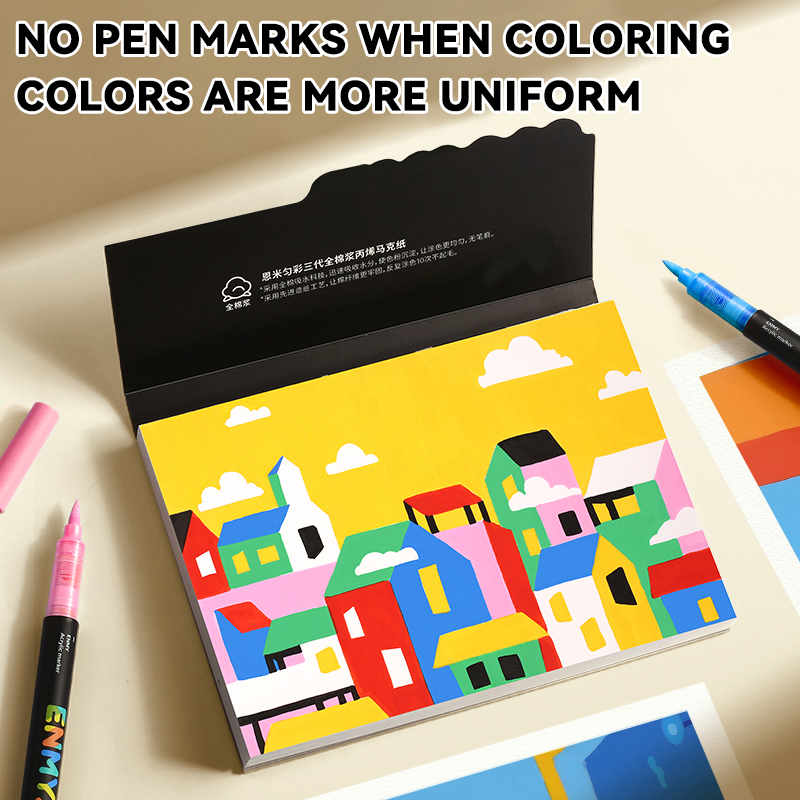
After the mid-20th century, with the rise of modern art, the “functionality” of drawing paper was further expanded: to meet the “waterproof and fast-drying” needs of acrylic painting, “acrylic paper” emerged, whose surface coating could prevent the penetration of acrylic pigments; to adapt to the combination of digital painting and traditional painting, “digital drawing paper” appeared, which allowed users to draw on the paper with a dedicated pen while synchronizing the image to electronic devices; the popularization of environmental protection concepts also promoted the development of “recycled drawing paper”—made from recycled waste paper pulp, it not only reduced resource consumption but also, due to the unique texture of its fibers, became a characteristic carrier for niche artistic creation.
Entering the 21st century, the “customization” trend of drawing paper has become increasingly evident: artists can customize drawing paper with specific sizes, fiber ratios, and coating thicknesses according to their creative needs; some high-end drawing paper brands still retain the handmade papermaking process, producing “collectible drawing paper” with unique textures through traditional techniques such as “natural drying and manual pressing”. These drawing papers are not only creative carriers but also have become a part of works of art.
V. Conclusion: Drawing Paper is More Than Just a “Carrier”
From the portability of papyrus and the ink-wetting property of rice paper to the specialized drawing paper of the industrial age and the functional carriers of modern times, the development history of drawing paper has always centered on the core of “better serving creation”. It has transformed from a “scarce luxury” to a “tool accessible to the public”, and from a “single form” to “diversified subdivision”. Every technological breakthrough has provided artists with a broader creative space.
Today, when we outline lines on sketch paper, blend colors on watercolor paper, and stack pigments on oil painting paper, drawing paper has long been more than just a “passive carrier”. Instead, it has become a “creative partner” as important as paintbrushes and pigments. Its texture, ink absorption, and durability directly affect the final presentation of works and even become an important factor in the formation of an artist’s style. With the continuous integration of technology and art, drawing paper in the future may present more unexpected forms, but what remains unchanged is always its core value as a “carrier of human creativity and colors”.
Share this article